Building Partner Services for the Agent Era
I recently pulled up the agent telemetry for a handful of customers across a few different partners. The numbers were fascinating.
One organisation had 331 monthly active agents. Another had over 1,000. A third partner's customer base? Thousands of agents already running. And not one of these environments had a governance framework in place. No registry. No lifecycle management. No visibility into what these agents were doing, what data they were accessing, or who was responsible when something went wrong.
If you're a Microsoft Partner reading this and thinking "that sounds like my customers," you're probably right. And if you're thinking "we should really be helping with that," you're definitely right.
This post is a practical signpost. Microsoft 365 E7 (the "Frontier Suite") goes GA on 1 May 2026, and Agent 365 ships with it. The window for partners to build services around this is right now, not after launch. I want to lay out where the opportunity sits, how two very different types of customer end up needing the same thing from you, and what you can go and do about it on Monday morning.
What Are We Actually Talking About?
Let me ground this quickly, because the naming can be confusing.
Microsoft 365 E7 is the first new enterprise tier since E5 launched in 2015. It bundles four things together at $99 per user per month:
- Microsoft 365 E5 (the full productivity, security, and compliance stack you already know)
- Microsoft 365 Copilot (the AI assistant, now included rather than bolted on)
- Microsoft Entra Suite (identity, Zero Trust Network Access, internet access controls)
- Agent 365 (this is the new bit)
Agent 365 is the control plane for AI agents across an organisation. Think of it as the governance layer that lets IT discover, register, monitor, secure, and manage agents built with Microsoft AI platforms, agents from Microsoft's ecosystem partners, and any agents you register yourself. It integrates with Defender, Entra, and Purview so security, identity, and compliance all wrap around agent operations.
Here's the bit that matters for partners: Agent 365 is not a product customers configure once and forget. It's an operational capability that needs design, implementation, tuning, and ongoing management. That is services work. Your services work.
And E7 isn't the only route in. Customers with Copilot are already encountering agent challenges. Agent sprawl doesn't wait for a licensing upgrade. The governance problem exists today, across your entire installed base.
Two Types of Customer, One Destination
Here's what I keep seeing in conversations with partners across the channel. There are two very different starting points for customers, but they converge on the same need.
Track A: "We Already Have Agents Running"
These customers have been experimenting. Their power users built agents in Copilot Studio. Someone in finance created a custom agent that processes expense reports. Someone in HR built one that answers policy questions.
The result? Dozens, sometimes hundreds, of agents running across the business with no central visibility. Nobody knows what data these agents can access. Nobody has tested what happens when they get things wrong. There's no registry, no lifecycle management, and no audit trail.
Their immediate problem is risk and control. They need to understand what's already running, assess the exposure, and put guardrails in place. The agent genie is out of the bottle and it's not going back in.
Track B: "We Want to Automate Business Processes"
These customers are at the other end. They've seen the demos. They understand that Copilot isn't just about writing emails and summarising meetings. They want to use AI agents to automate real business processes: customer onboarding, invoice processing, support ticket triage, compliance checking, and more.
But they don't know where to start. Which processes are good candidates? How do you measure success? What does the architecture look like? How do you make sure the agents are accurate, compliant, and actually saving money?
Their immediate problem is direction and validation. They need someone to help them identify the right use cases, prove value quickly, and build confidence before scaling.
Where the Tracks Meet
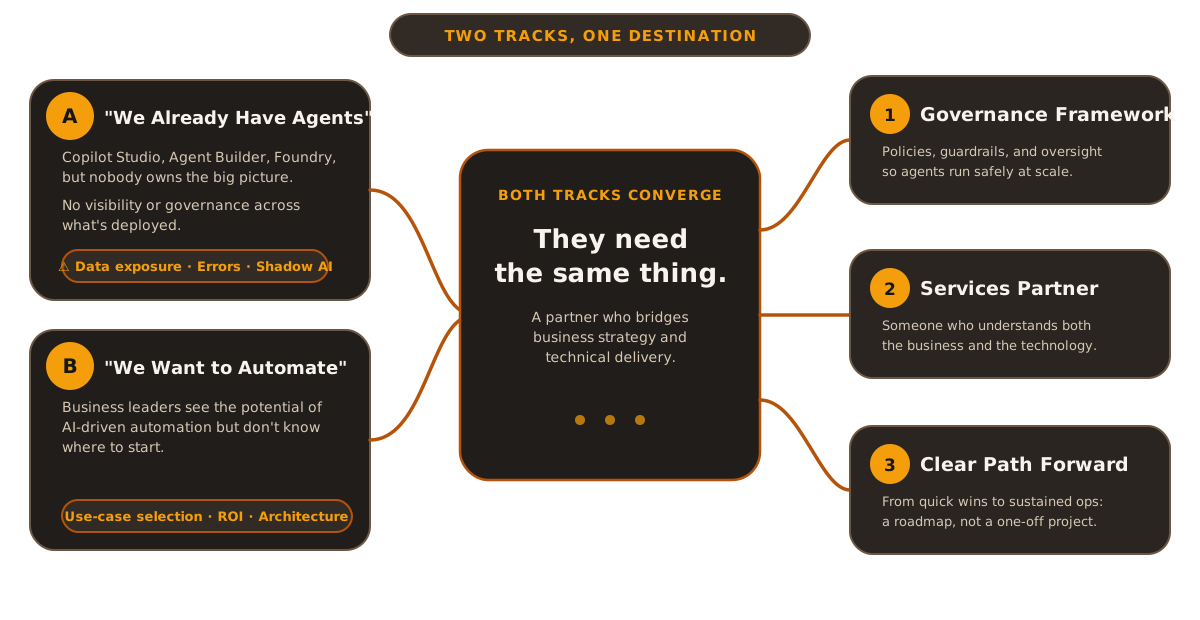
Both tracks end up in the same place. Track A customers need governance first and business process optimisation second. Track B customers need business process design first and governance alongside it. Either way, they need a partner who can do both, and who can start small and build up over time.
This is the point I really want to hammer home: you don't need to have all the answers on day one. You need a starting point and a direction of travel. The services mature as the customer matures.
Start Simple. Deliver Value. Build From There.
I've talked to too many partners who immediately try to 'boil the ocean', over complicating the solution and getting bogged down in minute details. Then they get overwhelmed by the investment required and do nothing.
Stop it. Start smaller.
The best services practices I've seen in the channel follow a staircase model. You start with something repeatable, chargeable, and low-risk, then build upward as the customer relationship deepens and the complexity of their needs grows.
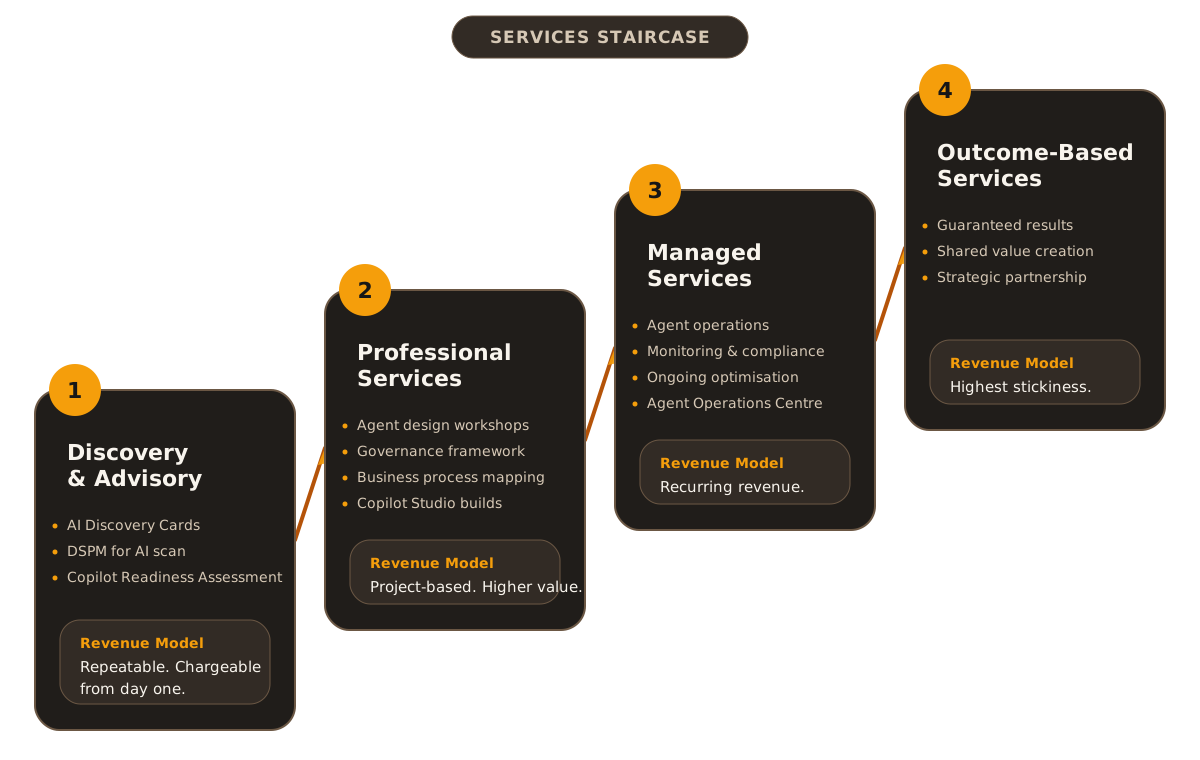
Step 1: Discovery and Advisory
This is your entry point. It's chargeable from day one and you can have it packaged within a week.
DSPM for AI (Data Security Posture Management for AI) is a discovery conversation you can run across every customer regardless of what SKU they're on. It maps where data is exposed, which AI tools are in use (sanctioned and unsanctioned), and what the risk profile looks like. This frames a services conversation before any licensing discussion even happens.
AI Discovery Cards are a structured, design-thinking workshop that maps business challenges to AI use cases. Simple. Repeatable. Chargeable. You're turning "we're exploring AI" into a paid engagement, and that's the mindset shift most partners need to make.
Copilot Readiness Assessments evaluate whether a customer's environment is actually ready for Copilot and agents: identity hygiene, data classification, security posture, change management readiness.
None of these require you to be an agent development shop. They require you to ask good questions and present findings clearly. If you can run a security assessment today, you can run these.
Step 2: Professional Services
Once you've run discovery, you'll have findings to act on. This is where you design and build.
Agent design workshops help customers identify their highest-value agent use cases and map out the architecture. Governance framework implementation puts the policies, controls, and monitoring in place. Business process mapping translates "we want to automate expenses" into a concrete specification. Copilot Studio builds deliver the actual agents.
This is project work. It has a defined scope, a start, and an end. Each engagement should lead naturally to the next step: who's going to run and maintain all of this once you've built it?
Step 3: Managed Services
This is where the real stickiness develops. You're not delivering a project any more; you're operating an ongoing service.
An Agent Operations Centre could monitor agent performance, catch errors, manage compliance, handle lifecycle (provisioning, updating, decommissioning agents), and continuously optimise. If you already run a Security Operations Centre, you have most of the operational muscle you need. The tooling and the subject matter are different, but the operating model is familiar.
The customer conversation shifts from "what will this cost?" to "what will this deliver, every month?" Recurring value is always worth more than one-time delivery.
Step 4: Outcome-Based Services
This is where you guarantee business results. You're not billing for time or for agent count; you're billing for outcomes. Reduced processing time. Lower error rates. Improved compliance scores. You share in the value you create.
Very few partners are here today, and that's fine. The point is to know the direction of travel. You start at step 1 and build towards step 4 as your capability and your customer relationships deepen. Each step makes the next one possible.
The Agent Maturity Ladder
There's another lens that's useful here: where are your customers on the agent maturity curve, and what services attach at each level?
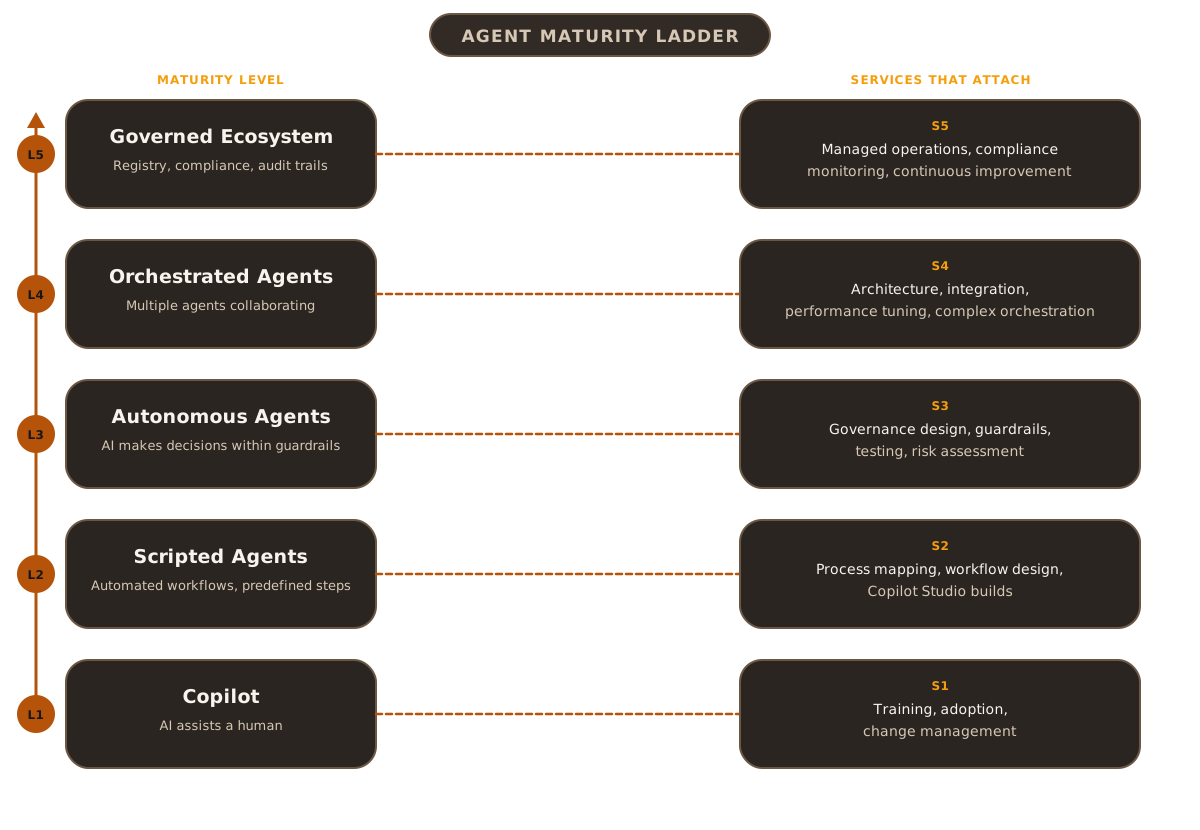
Most customers are at level 1 or 2. They're using Copilot for productivity (summarising meetings, drafting emails) and maybe they've built a few agents in Agent Builder or Copilot Studio.
But the ones at level 1 and 2 who have been busy building? They've created a level 5 problem. They have an unmanaged agent estate that needs governance now, even though they haven't matured through levels 3 and 4 yet.
That gap between where most customers sit (level 1-2) and what they actually need (level 5 governance) is your services opportunity. You don't need to help every customer climb every rung sequentially. Many need to jump to governance first and then work on maturing their agent capabilities within that framework.
This is the opposite of the traditional adoption curve. Usually you build capability first, then add governance. With agents, the governance has to come first (or at least in parallel), because the risk of ungoverned agents is too high and the proliferation is already happening.
What to Do on Monday Morning
I'm conscious that a 3,000-word post about services strategy is useless if it doesn't end with something you can actually go and do. So here are five things you can start this week.
1. Audit your customer base for agent active users.
Pull the data. Look at agent MAU and any custom agent deployments you're aware of. The numbers will surprise you. I've yet to meet a partner who wasn't shocked by how much agent activity was already happening across their accounts. That data is your prospecting list for services conversations.
2. Package a repeatable discovery engagement.
Pick one: DSPM for AI, AI Discovery Cards, or a Copilot Readiness Assessment. Define the scope, the deliverables, the price, and the timeline. Make it something your pre-sales team can pitch next week. It doesn't need to be perfect. It needs to exist.
3. Pick one customer and run a pilot.
Don't wait for E7 GA on 1 May. The governance problem exists today for any customer with agents. Find a customer with visible agent sprawl (your audit from action 1 will tell you who), offer them a discovery engagement, and deliver it. You'll learn more from one real engagement than from six months of internal planning.
4. Train your team on the three-level Copilot conversation.
Most partner sales teams sell Copilot at level 1: "it helps you write emails and summarise meetings." The real revenue is at level 3: "it's the foundation for an agent ecosystem that runs your business." Get your pre-sales and account teams talking about process automation and governance, not just productivity. The licensing conversation gets much bigger when the customer sees the platform, not just the assistant.
5. Start the managed services conversation early.
Don't wait until you've finished a professional services engagement to mention managed services. Plant the seed in the discovery phase: "Once we've built this governance framework, who's going to operate it day-to-day?" The customer is thinking about it even if they're not saying it out loud. The earlier you position managed services as the natural next step, the higher your conversion rate.
And one more thing, the one that matters most: licensing follows services. Not the other way around. The partners I think will close the biggest E7 deals are the ones who lead with a services conversation about governance and agent operations, and the licensing decision is a natural consequence. If you lead with the SKU, you end up in a procurement conversation about price. If you lead with the problem, you end up in a business conversation about value.
The Clock Is Ticking
The risk for partners right now isn't that E7 is complicated or that Agent 365 is hard to understand. The risk is that your customers are already building and deploying agents without you. They're doing it themselves, because nobody has offered them a better option.
The customers with 1 agent, 331 agents, or with 1,000 agents? They didn't wait for a partner to show up with a proposal. They just got on with it. And now they have a governance problem that's growing every week.
You can be the partner who helps them solve it, or you can be the partner who eventually sells them the licence after someone else has done the hard work. The services opportunity is right there. Start simple. Deliver value. Build from there.
The agents aren't waiting. Neither should you.